

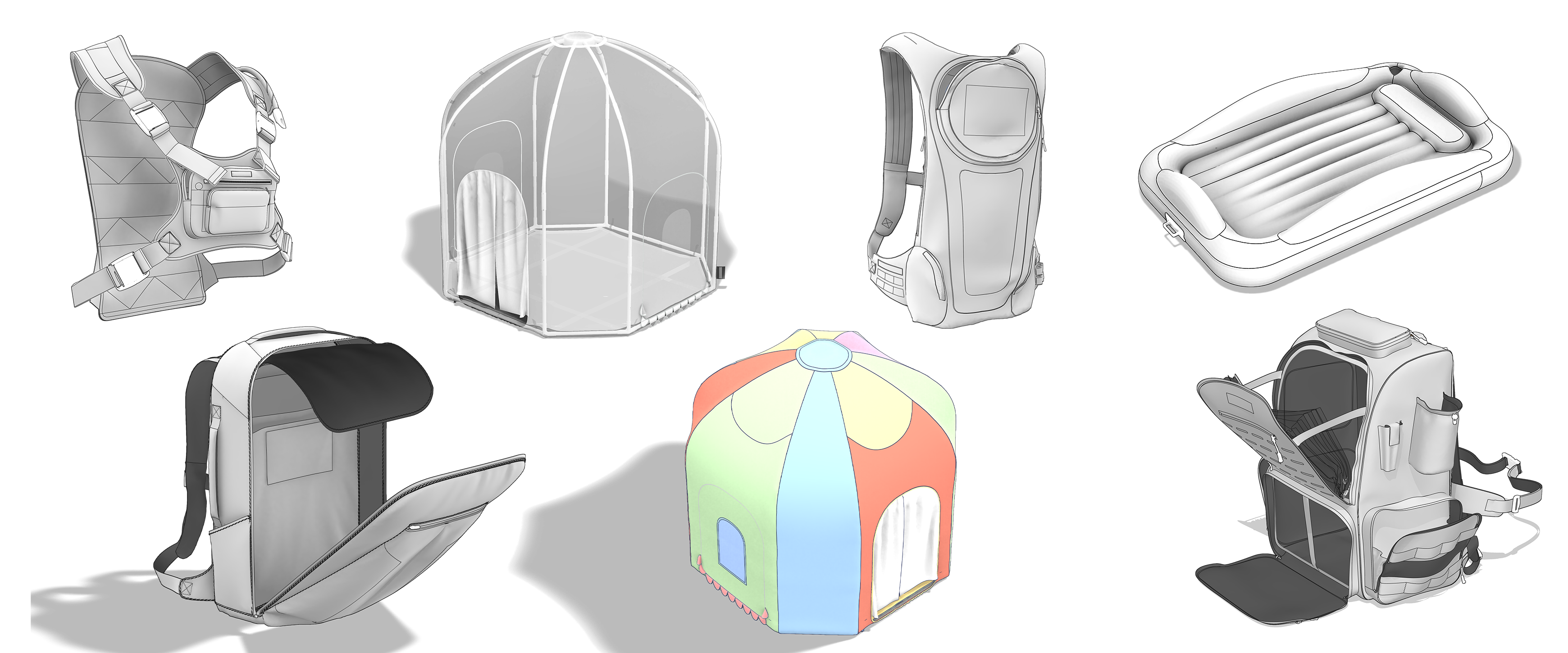
Template and example for bags and soft goods
A tech pack is the set of drawings, measurements and material details a factory needs to make a sewn product without guessing. If the factory has to guess, it fills the gaps with whatever is cheapest or quickest, and you find out when the sample arrives.
This guide covers what goes in a tech pack, a template you can copy, and a worked example for a backpack. It is written for people making bags, pouches, baby products, pet gear and other soft goods, though most of it applies to clothing too.
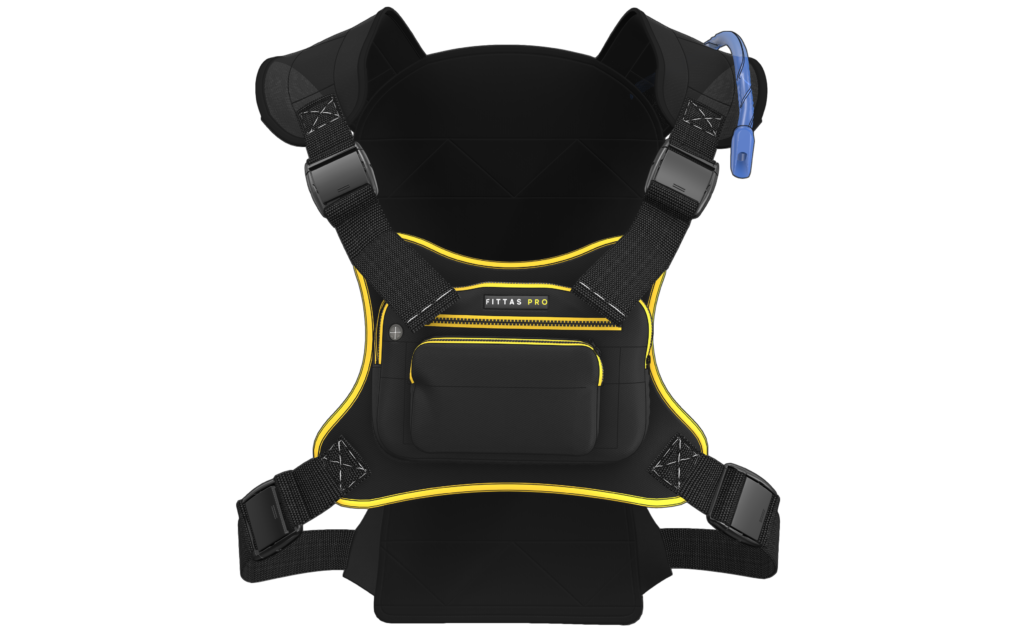
What a tech pack is for:
A factory quotes, cuts and sews from documents. It doesn’t see the picture in your head. A tech pack puts every decision on paper so that three things can happen:
- The factory can give you an accurate price, because it knows the materials, the hardware and how long the sewing takes.
- The first sample comes back close to what you wanted.
- You have something to check the sample against. When a strap is 20 mm short, you can point to the page that says so.
It also protects you if you change factories. The tech pack belongs to you, so a second factory can pick up the same product without starting again.
What goes in a tech pack
There is no single official format. These are the sections most factories expect, and the ones Oxta Design includes for soft goods.
| Section | What it contains | Why the factory needs it |
| Cover page | Product name, style number, version, date, your contact | So everyone works from the same revision |
| Technical flats | Line drawings of front, back, sides, top, base and inside. No shading | Shows the shape and where every panel and seam sits |
| Construction details | Close-ups of seams, edge finishes, reinforcement, zip ends, strap anchors | Tells the machinist how each join is made |
| Measurement sheet | Every key dimension with a tolerance, such as 450 mm ± 5 mm | The basis for checking samples |
| Bill of materials | Each fabric, lining, foam, webbing, zip, buckle and thread, with supplier or spec, colour and quantity | The factory prices and buys from this list |
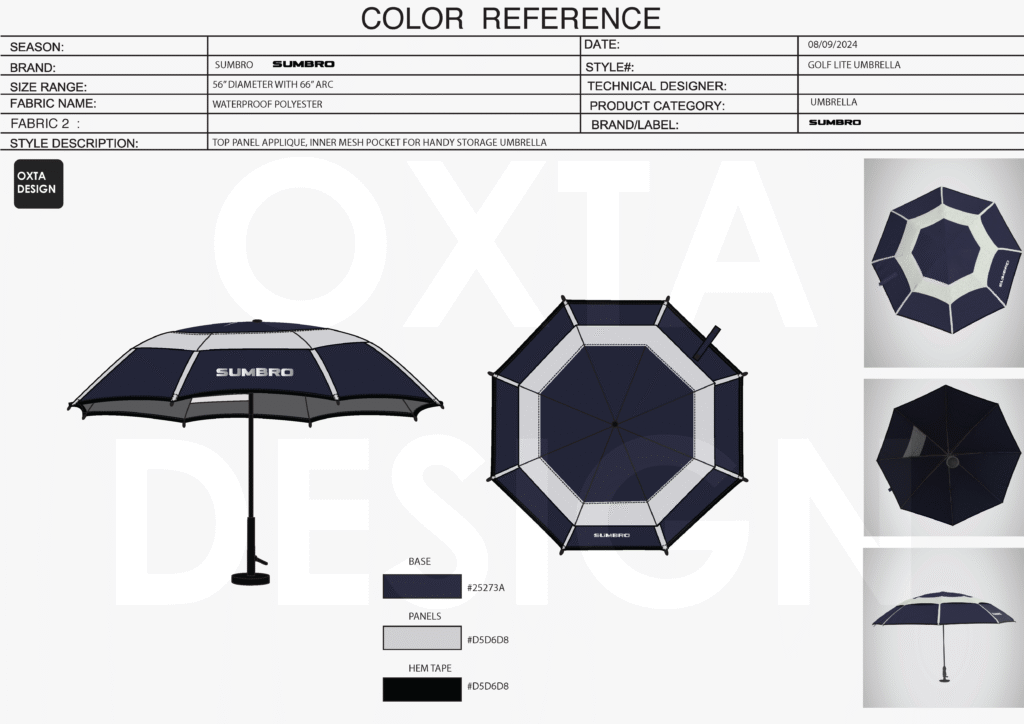
| Colourways | Which colour goes on which panel, with Pantone or supplier references | Stops “navy” arriving as three different blues |
| Artwork and labels | Logo files, print or embroidery method, size and position, care label wording | Branding is where most small errors happen |
| Pattern pieces | The flat shapes each panel is cut from, with seam allowances | Speeds up sampling and keeps the shape yours |
| Packaging | Polybag, swing tag, carton quantity, barcode position | Needed for the final price and for shipping |
| Revision log | What changed between versions and when | Avoids the factory sewing from an old page |
A tech pack for a simple pouch can be four or five pages. A backpack with a frame sheet, padded straps and several pockets often runs past twenty.
Tech pack template
- Product summary. One paragraph: what it is, who it is for, target retail price, target order quantity.
- Overall size. Height, width and depth when filled, plus capacity in litres if it is a bag.
- Views. Front, back, both sides, top, base, interior. Number every panel.
- Panel list. Panel number, name, material, colour, quantity per unit.
- Seam schedule. Seam type, stitch type, stitches per 10 cm, seam allowance, thread.
- Reinforcement. Where bartacks, box stitches, binding and backing patches go.
- Hardware. Zips (type, size, length, slider, puller), buckles, D-rings, snaps, hook and loop.
- Padding and structure. Foam type, thickness and density. Stiffeners and frame sheets.
- Measurement sheet. Points of measure with tolerances and a diagram showing where each is taken.
- Branding. Artwork file names, method, size, position measured from a fixed edge.
- Labels. Care label, size or batch label, country of origin, position.
- Testing notes. Load each strap must hold, any water resistance requirement, any safety standard that applies.
- Packaging. How each unit is packed and how many per carton.
- Revision log.
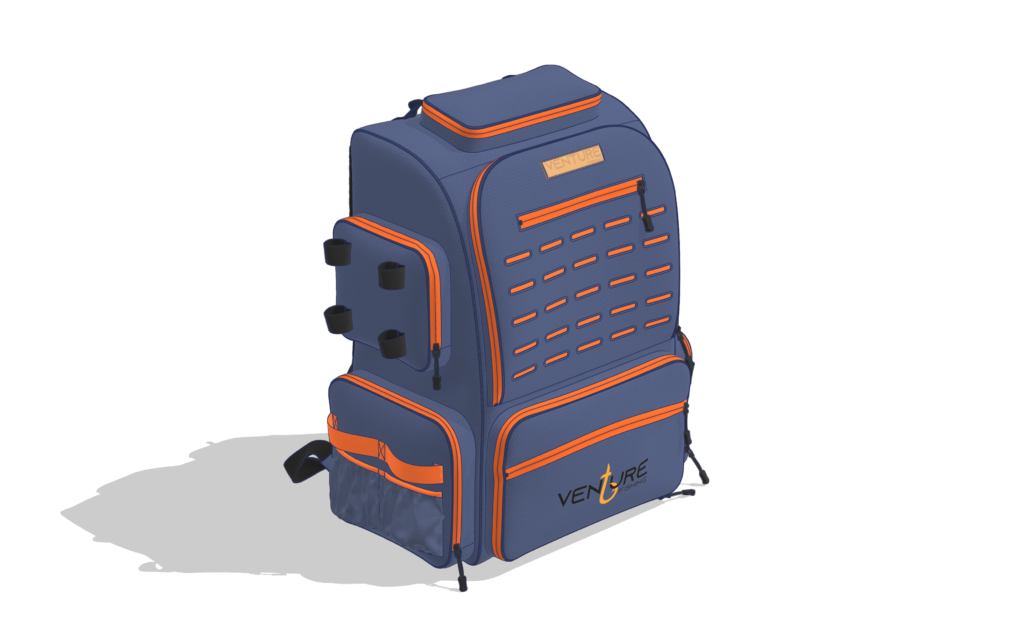
Tech pack example: a 20 litre roll-top backpack
This is an illustrative example to show the level of detail. The numbers are made up for the purpose.
Cover. Roll-top daypack, style RT-20, version 3.
Overall size. 480 mm high rolled, 290 mm wide, 150 mm deep. 20 litres.
Bill of materials (extract).
| Item | Spec | Colour | Used on |
| Main fabric | 500D nylon, PU coated | Blue | Body panels 1 to 4 |
| Base fabric | 1000D nylon, PU coated | Black | Base panel 5 |
| Lining | 210D ripstop nylon | Light grey | Interior |
| Back panel foam | 8 mm closed-cell EVA | n/a | Panel 2 |
| Webbing | 25 mm nylon, flat weave | Black | Shoulder straps, roll-top closure |
| Buckle | 25 mm side release | Black | Roll-top closure, 1 per unit |
| Front zip | No. 5 coil, reverse, 220 mm | Black | Front pocket |
Measurement sheet (extract).
| Point of measure | Target | Tolerance |
| Body height, base seam to top edge unrolled | 620 mm | ± 5 mm |
| Body width at base | 290 mm | ± 3 mm |
| Shoulder strap length, fully extended | 850 mm | ± 10 mm |
| Front pocket opening | 220 mm | ± 3 mm |
Construction note (one of many). Shoulder strap top anchor: strap sewn into the back panel seam, then box stitch with cross, 25 mm by 25 mm, through a backing patch of base fabric on the inside.
Look at that last line. Without it, a factory might run a single row of stitching through the strap. It would pass a visual check and tear out after a few months of use.
Who makes a tech pack
You can write one yourself if you can draw accurate flats and you understand how sewn products go together. Most founders can describe the product well but get stuck on construction and measurements, and those are the pages a factory relies on.
A soft goods designer builds the product first and writes the tech pack from the result. At Oxta Design the bag or product is modelled in CLO 3D, which simulates the real pattern pieces sewn together in fabric. The shape, fit and proportions get checked on screen before anything is cut, and the pattern pieces come straight out of the same model. That removes a round or two of physical samples. Read more about soft goods design and how it works.
Some factories offer to write the tech pack for you. It is quick, but the document then describes what suits that factory, and you may not be given the patterns.
What happens after the tech pack
The tech pack goes to one or more factories for a quote and a first sample. Oxta Design arranges soft goods prototypes through manufacturing partners overseas. Allow at least three weeks for each sample round.
The first sample is rarely right. You check it against the measurement sheet, mark up what needs to change, update the tech pack to the next version and go again. Two or three rounds is normal for a bag.
If the product is one part of a bigger launch, the tech pack sits in the middle of a longer process. The new product development page sets out the stages either side of it.
Common mistakes
- Reference photos instead of drawings. “Like this bag but bigger” isn’t a specification. The factory will copy the photo.
- No tolerances. Fabric stretches and sewing varies. A dimension without a tolerance can’t be checked.
- Vague materials. “Waterproof canvas” could mean ten fabrics at ten prices. Give weight, weave and coating, or name the supplier’s product.
- Missing hardware sizes. A zip needs a type, a size number, a length and a slider. So does every buckle.
- No version number. Then nobody knows which page is current.
FAQs
What is a tech pack in simple terms?
A tech pack is an instruction document for a factory. It shows what a sewn product looks like from every side, how big each part is, what it is made from and how it is put together, so the factory can quote and make it accurately.
Is a tech pack the same as a pattern?
No. A pattern is the set of flat shapes the fabric is cut from. A tech pack is the whole document, and it usually includes the pattern pieces along with drawings, measurements, materials and branding.
How much does a tech pack cost?
It depends on how complex the product is and how much design work is still to do. A pouch with one zip is a small job. A structured backpack with a dozen panels is not. Oxta Design quotes a fixed fee per stage after reviewing your brief, and the product design cost page gives typical ranges.
Can I send a tech pack to a factory overseas?
Yes, and most soft goods factories expect one. Use millimetres, plain English and clear diagrams, since the reader may be translating. Sign a non-disclosure agreement with the factory before you send it.
Do I need a tech pack for a small first run?
Yes. A small run costs more per unit, so a wrong sample hurts more. The tech pack is also what lets you move to a bigger factory later without redesigning the product.